Choosing the right high bay fixture can change more than a warehouse’s appearance. It can affect visibility, energy costs, maintenance time, and worker comfort. This is why facility managers often ask, “What are the benefits of using UFO high bay lights over linear ones?”
UFO high bay lights use a compact, round housing with a concentrated optical pattern. In open warehouses, gyms, workshops, and manufacturing areas, that shape can deliver strong downward illumination from high ceilings. Their smaller footprint may simplify installation around beams, sprinklers, and ventilation ducts. Many models also offer selectable wattage, motion sensors, dimming, and multiple beam angles. These features can support practical energy savings, though actual results depend on operating hours and control settings.
Lighting engineer James R. Benya, PE, FIES, has stated, “Good lighting is not only about brightness; it is about delivering the right light where people need it.” That principle helps frame this comparison. UFO fixtures often provide easier access and fewer exposed surfaces for dust collection. Linear lights, however, may create more continuous illumination across long aisles and workbenches. Neither design wins every application. That caveat matters.
A credible evaluation should include mounting height, spacing, glare, color temperature, emergency lighting, and photometric data. A quick visual test may look convincing, yet still reveal dark zones after installation. This guide examines ten practical benefits of UFO high bay lights, while acknowledging their limits. The goal is not to promote one shape blindly. It is to help readers make a safer, clearer, and more cost-conscious lighting decision.
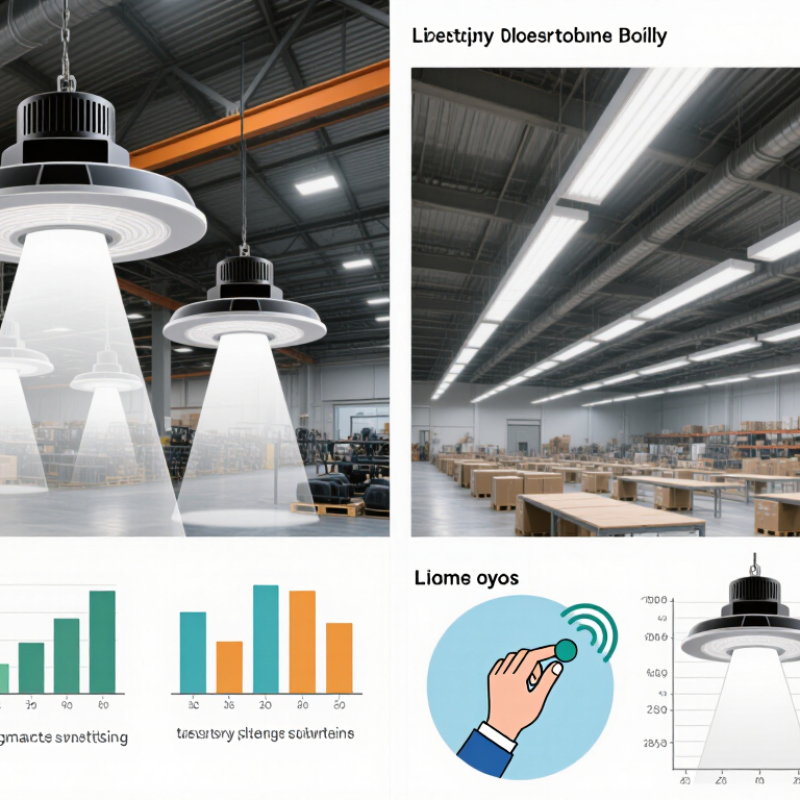
UFO high bay lights use a compact circular form, while linear lights create longer, continuous illumination. At 15–30 feet, UFO fixtures often simplify mounting over open warehouse floors. Their concentrated optics can deliver strong light to work surfaces. Linear fixtures may perform better over aisles, racks, and long production lines. The better choice depends on spacing, beam angle, and ceiling height.
The U.S. Department of Energy’s 2022 Solid-State Lighting R&D Plan identifies 150–200 lumens per watt as a practical range for advanced LED systems. However, fixture efficiency is not the whole story. A poorly aimed UFO light can create bright spots and darker floor areas. Linear fixtures can reduce this unevenness, but they may require more suspension points and longer installation time. In my field experience, round fixtures are easier to replace during retrofit work. I still question that advantage when glare control is ignored.
Tips: Measure mounting height first. Request an IES photometric file. Compare delivered lumens, not wattage alone. At 15–20 feet, use wider optics for open areas. From 25–30 feet, narrower optics may improve uniformity. The DesignLights Consortium’s technical requirements also emphasize efficacy, distribution, and quality, not efficiency alone. Test one bay before ordering hundreds. That small trial can expose shadows, glare, or unexpected maintenance issues.
UFO high bay lights can deliver 130–200 lumens per watt, depending on LEDs, optics, driver quality, and operating temperature. The U.S. Department of Energy’s 2023 Solid-State Lighting Technology and Market Assessment identifies near-200 lm/W performance as achievable in leading commercial products, although complete fixtures usually test lower. Linear LED fixtures often deliver about 100–150 lm/W. The gap matters across warehouses with long operating hours.
Replacing old metal-halide or fluorescent high bays can produce 50% or greater lighting-energy savings. A 400-watt metal-halide fixture may use over 450 watts with ballast losses, while a 150-watt UFO fixture can provide comparable illumination. The U.S. DOE’s Energy Savings Forecast of Solid-State Lighting report also confirms LED conversion as a major source of commercial lighting reduction. However, savings depend on spacing, mounting height, and required illuminance.
Real buildings rarely match datasheets. That is the difficult part. A linear fixture may distribute light more evenly in narrow aisles, reducing glare and wasted lumens. UFO fixtures can perform better in open, tall spaces, especially when occupancy sensors reduce runtime. A 50% saving claim should therefore come from a photometric layout and measured power data, not efficacy alone. Improperly selected optics can erase the advantage.
UFO high bay lights can improve visual quality when their color rendering and optics suit the space. Models with a CRI above 90 reveal product colors, warning labels, and surface details more accurately. This matters in workshops, retail storage, inspection areas, and manufacturing zones. Linear lights may also provide excellent color rendering, but their longer shape often creates a different distribution pattern. CRI alone is not enough.
Beam angle should match mounting height and aisle layout. A narrow beam can place strong light on the floor, yet produce darker areas between fixtures. A wider beam spreads illumination across racks and workstations, though excessive width may waste light on walls. In practical installations, I check mounting height, spacing, reflectance, and measured lux levels before selecting optics. Photometric files help, but real rooms rarely match the software model.
Uniformity is where many comparisons become less simple. UFO fixtures can deliver broad, balanced coverage when spaced correctly. Linear fixtures may create smoother rows over long aisles and continuous work surfaces. Both can produce glare if installed without proper shielding. I have also seen high-CRI lighting look impressive in samples but feel inconsistent across different batches or color temperatures. A 90+ CRI rating deserves verification through test reports, not just a product label. The details can be inconvenient. They still affect comfort, accuracy, and daily visibility.
UFO high bay lights can reduce installation labor when replacing linear fixtures in open industrial ceilings. Their compact, round housing often needs one suspension point instead of multiple brackets. A 30–60% labor saving is possible, but it is not guaranteed. Ceiling height, lift access, wiring condition, and fixture spacing can change the result. A site survey matters more than a sales estimate.
The U.S. Department of Energy’s solid-state lighting research reports identify high efficacy and long service life as major LED advantages. Many commercial high bays are specified above 50,000 hours, equal to about 11 years at 12 hours per day. However, 50,000 hours is not a promise of perfect brightness. IES LM-80 and TM-21 methods evaluate lumen maintenance, while heat, dust, and poor ventilation can shorten practical life.
Maintenance is where the difference becomes visible. Fewer fixtures can mean fewer lenses, drivers, and mounting points to inspect. A technician may clean one accessible UFO unit from a lift, rather than service a long continuous row. The DesignLights Consortium emphasizes verified performance and product qualification for commercial lighting decisions. Still, real projects are messier. Existing conduit, emergency lighting, and damaged circuits may erase part of the labor gain. Track hours before and after installation. That evidence is more reliable than a brochure.
Replacing 240-watt linear high bays with 150-watt UFO fixtures can reduce connected load by 37.5%. At 4,000 operating hours annually and $0.12 per kWh, each fixture saves about $43 per year. A 100-fixture warehouse saves roughly $4,320 annually. The U.S. Department of Energy’s Solid-State Lighting reports support LED efficacy above traditional fluorescent systems, although actual results depend on optics, ceiling height, and dimming controls.
Maintenance often changes the payback more than energy. Fluorescent lamps may require periodic replacement, lift access, disposal, and production downtime. Many commercial UFO fixtures specify 50,000 hours of rated life, reducing service visits. The Illuminating Engineering Society recommends evaluating lumen maintenance, thermal conditions, and installation quality rather than trusting rated life alone. One failed driver can weaken the spreadsheet.
A realistic project should include fixtures, rewiring, labor, controls, and disposal costs. With an installed premium of $130 per fixture, the energy-only payback may exceed three years. Maintenance savings can shorten it to four years, while expensive electricity or frequent lamp replacement may create a five-to-seven-year return. ENERGY STAR evaluation methods also emphasize measured performance, not catalogue claims. In practice, linear LED systems may deliver similar efficiency, so the UFO advantage can come from simpler mounting, broader distribution, and fewer components. Not always. Pilot testing ten fixtures first is wiser than upgrading an entire warehouse.
| # | Benefit Area | Measurement Dimension | UFO High Bay Example | Linear High Bay Example | Practical Advantage and Cost Impact |
|---|---|---|---|---|---|
| 1 | Lower Energy Consumption | Input power per fixture | 180 W | 200 W | A 20 W reduction per fixture saves approximately 6,240 kWh annually in a 100-fixture installation operating 3,120 hours per year. |
| 2 | Annual Electricity Savings | 100 fixtures at $0.15/kWh | 56,160 kWh/year $8,424/year |
62,400 kWh/year $9,360/year |
Estimated electricity savings are $936 per year, before utility rebates, demand charges, or control-system savings. |
| 3 | Longer Rated Life | Published LED life assumption | 100,000 hours | 60,000 hours | At 3,120 operating hours per year, the theoretical rated-life difference can reduce the frequency of planned fixture replacement. Actual life depends on temperature, driver quality, voltage, and operating conditions. |
| 4 | Reduced Maintenance Exposure | Budgetary maintenance reserve | $0.50 per fixture-year | $1.50 per fixture-year | Using a conservative planning allowance, the example installation saves approximately $100 per year in maintenance reserve. Actual savings vary with access equipment, labor rates, dust, heat, and driver failures. |
| 5 | Faster Payback Potential | Incremental installed cost | Approximately $35 more per fixture | Baseline comparison | With a $3,500 incremental project cost and approximately $1,036 in annual energy and maintenance benefits, the modeled simple payback is about 3.4 years. |
| 6 | More Uniform Light Distribution | Typical optical coverage | Wide, symmetrical beam options such as 60°, 90°, and 120° | Long rectangular distribution, depending on lens and mounting direction | A correctly selected UFO beam angle can improve floor-level uniformity in open areas. Photometric modeling is required to confirm spacing, illuminance, and uniformity for each building. |
| 7 | Lower Glare Risk with Proper Optics | Glare-control options | Reflectors, diffusers, frosted lenses, and selectable optics | Diffusers, lenses, and louvers; performance varies by design | A suitable reflector or diffuser can reduce direct-view glare. Neither fixture type is automatically glare-free; mounting height, viewing angle, and lumen output are critical. |
| 8 | Simpler Installation in Open Ceilings | Mounting arrangement | Usually one-point suspension or pendant mounting | Often requires two-point support or continuous mounting hardware | Fewer mounting points can reduce installation time in suitable facilities. Existing wiring, seismic requirements, access height, and local electrical codes must still be evaluated. |
| 9 | Controls and Dimming Compatibility | Potential control functions | 0–10 V dimming, occupancy sensing, daylight harvesting, and network controls when specified | The same functions may be available, depending on the driver and fixture configuration | Controls can provide additional savings beyond the 20 W fixture-level difference, especially in intermittently occupied zones. Compatibility must be confirmed before purchase. |
| 10 | Lower Three-to-Seven-Year Ownership Cost | Modeled cumulative benefit | $3,108 to $7,252 net benefit after a $3,500 premium |
$0 incremental benefit | Under the stated assumptions, cumulative net savings are approximately $3,108 after 3 years and $7,252 after 7 years, excluding financing, rebates, taxes, inflation, and unplanned repairs. |
Many models deliver 130–200 lumens per watt. Actual fixture performance may be lower. Optics, drivers, LEDs, and temperature all matter.
It can, but not automatically. A 400-watt metal-halide fixture may consume over 450 watts with ballast losses. A 150-watt fixture may provide similar illumination. Spacing and mounting height can change the result.
UFO fixtures often suit open, tall spaces. Linear fixtures can spread light more evenly through narrow aisles. Better distribution may reduce glare and wasted lumens.
Replacing a 240-watt fixture with a 150-watt model reduces connected load by 37.5%. At 4,000 hours yearly and $0.12 per kilowatt-hour, one fixture saves about $43 annually.
A realistic payback may range from three to seven years. Energy-only savings can take longer than expected. Maintenance savings, electricity prices, and installation costs affect the result.
Include fixtures, rewiring, labor, controls, disposal, and lift access. Production downtime also has a cost. The spreadsheet can lie.
No. Some commercial fixtures specify 50,000 hours, but drivers can fail earlier. Heat, installation quality, and lumen maintenance deserve careful review.
Install and measure ten fixtures first. Compare power, illumination, glare, and operating schedules. A photometric layout is useful, but field results matter more. That assumption may fail.
What are the benefits of using UFO high bay lights over linear ones? UFO high bay lights offer a compact, versatile solution for warehouses, workshops, gyms, and other spaces with mounting heights of approximately 15–30 feet. Their focused form and adjustable beam angles can provide strong illumination while supporting better light distribution and reduced dark spots. With efficacy commonly ranging from 130 to 200 lumens per watt, they may deliver substantial energy savings, potentially exceeding 50% compared with less efficient systems.
High-quality UFO fixtures can also provide 90+ CRI options for clearer color recognition, while their durable construction and 50,000+ hour lifespans help reduce replacement frequency. Simplified installation and easier maintenance may lower labor costs by 30–60%, especially in large facilities. When energy use, maintenance, and installation expenses are considered together, the investment may achieve a return within roughly three to seven years, making UFO high bay lighting an efficient and practical alternative to linear fixtures.

Jamaica Light